
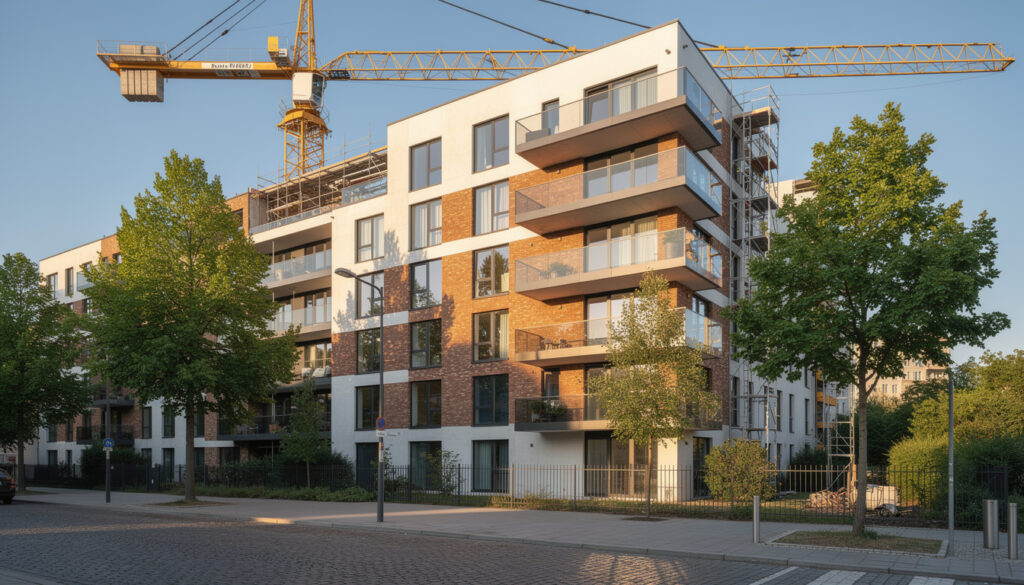
How Berlin Off-Plan Property Investment Works for Foreign Buyers follows one structure: international investors purchase unbuilt or under-construction residential units through a notarized developer contract. They pay in staged installments tied to verified building progress until ownership is registered and the unit is handed over. An Off-plan (new-build) purchase places the asset, the schedule and the counterparty risk in the future. This guide covers eligibility, milestone payments and extra costs, non-resident financing, contract protections, pre-signing risk controls, and the long-term fundamentals of Berlin off-plan property investment.
Can a Non-Resident Buy Off-Plan in Berlin?
Legal Eligibility and Practical Barriers
Foreign nationals can acquire full freehold ownership of off-plan apartments in Berlin regardless of citizenship or residency, and no permit is needed. The barriers are administrative: strict Know Your Customer and anti-money-laundering checks, certified passport copies, proof of address, source-of-funds documentation, and certified translations of non-German documents. Buyers unable to attend usually arrange a notarized, apostilled power of attorney, or use remote verification where German notarial procedure permits it.
Reservation to Handover and Registration
The workflow starts with unit selection and a reservation fee, where one is charged. Next come review of the draft Bauträgervertrag (developer purchase contract), the Notary appointment, and a priority notice of conveyance in the Land registry (Grundbuch). Construction-linked installments follow, then Handover (Übergabe) and the final ownership entry in the Land registry (Grundbuch). The developer delivers the unit to specification. The neutral notary certifies the contract, checks conditions and files registry applications. A lender, if involved, releases mortgage tranches. The federal portal outlines the mandatory notarization and registration process through which ownership actually passes.
Payment Stages Mapped: What Is Paid, When, and What Else Costs Money
What Is Paid and When During Construction
A Down payment / reservation fee is usually settled before notarization, and its refundability should be confirmed in case the deal never reaches the notary. Purchase price installments follow verified Construction milestones rather than one upfront sum. Escrow-style payment safeguards block the first installment until the contract is valid, the priority notice is registered, and permit and collateral confirmations exist.
| Stage | Trigger | Cash-flow note |
|---|---|---|
| Reservation | Unit chosen, before notary | Refund terms vary |
| Foundation | Certified excavation and foundation | First installment, only after safeguards |
| Shell and roof | Structure and windows certified | Paid to project or controlled account |
| Fit-out | Interior works certified | Further installment |
| Handover | Protocol signed | Final installment, after defects noted |
International wires add settlement time, compliance holds and conversion, so milestone notices call for liquidity held in readiness.
Transaction Taxes, Closing Fees, and Ongoing Costs
Property transfer tax (Grunderwerbsteuer) is assessed on the purchase price at Berlin's rate of 6%, and the Berlin transfer tax service page describes how it is calculated and administered. Notary certification, land registry filing, brokerage commission where applicable, and mortgage arrangement or valuation fees come on top. VAT treatment differs between standard long-term residential rental and commercial or serviced-apartment structures, which can affect pricing and cash flow. After completion, Service charges / homeowners association fees (Hausgeld), property tax, reserve fund contributions, management fees for non-resident owners and landlord insurance reduce net returns.
Bank Loan or Cash? How Non-Resident Financing Differs
A Non-resident mortgage is harder to obtain, since fewer German banks lend to buyers living abroad or earning in non-euro currencies. Loan-to-value (LTV) limits run more conservative than for residents, so substantial equity is needed upfront. Lenders also ask for multi-year tax returns, salary slips or corporate financials, bank statements and credit reports. Appraisals of unbuilt units rely on architectural plans, floor area in square meters and projected values. The developer's Project financing needs separate scrutiny from the buyer's own loan.
A build of 18 to 36 months can outlast approval validity or rate locks, and commitment fees accrue on undisbursed amounts. Staged drawdowns require sequencing equity and bank tranches, sometimes with bridging liquidity. Currency exchange (FX) risk adds another layer: investors earning in USD, GBP, CHF or ILS face staggered euro payments whose effective home-currency cost can swing materially.
When the Handover Slips: Delay Clauses, Defects, and Warranty
A Bauträgervertrag in an Off-plan (new-build) purchase sells a land share plus an obligation to build to attached specifications, with floor areas in square meters and room dimensions in meters and centimeters. Upgrades and change orders are priced, approved and scheduled in writing, and substitution rules cover fixtures that become unavailable.
Berlin timelines stretch through permitting bottlenecks, utility connection backlogs, contractor insolvency and supply-chain disruption. A Construction delay clause matters only if it separates a target date from a binding handover deadline. Remedies such as delay penalties or termination rights usually apply after a formal grace period. At Handover (Übergabe), an independent Snagging / defects inspection records unfinished items on the protocol before the final installment is released. Afterwards, the Defect liability period (Gewährleistung) governs how structural and non-structural defects are reported, documented and rectified within statutory or contractual windows.
Common Mistakes Before Signing at the Notary
The main failure points in Berlin off-plan property investment are Developer insolvency risk that leaves a building half-finished, prolonged delays that create double-carrying costs, unapproved specification downgrades, post-completion valuations below contract price, and unhedged Currency exchange (FX) risk.
Most are avoidable through checks by independent legal and technical advisers. Frequent mistakes include skipping the Land registry (Grundbuch) extract for title and encumbrances, and accepting a pending application instead of a granted Building permit (Baugenehmigung). Others are ignoring the developer's corporate structure, Berlin reference projects and bank-backed Project financing. Contract red flags include vague completion dates, unilateral price-adjustment clauses, weak delay penalties and missing milestone verification. Micro-location is judged by distance in kilometers or meters to transit, schools and employment hubs, with rentability tested against local data rather than developer projections.
Metrics That Test Returns, Exit Options, and Investor Fit
Gross yield can mislead. Net yield is what remains after Service charges / homeowners association fees (Hausgeld), maintenance reserves, non-resident tax and accounting administration, and management fees. Berlin's rent-pricing rules may treat new-build units differently from older stock, but applicability to the specific unit needs verification before underwriting, and tenanting after handover takes time. Exit liquidity depends on holding period, resale demand, and the friction of selling before rather than after completion.

Investor fit varies. Capital-preservation buyers favor modern, energy-efficient stock, judged by standard energy ratings in kWh per square meter per year. Income-focused buyers trade lower initial yields for low immediate capex. Buyers weighing future personal use accept less rental optimization.
Do foreign buyers need German residency for an off-plan purchase in Berlin?
No. Residency and citizenship are not conditions of ownership, though identity and source-of-funds verification apply to every buyer.
Is the full price paid before construction begins?
No. Payment is split into installments tied to certified progress, and the first one falls due only after contractual safeguards are met.
What happens if completion is delayed?
The remedy depends on the contract wording. Delay penalties or termination rights typically apply once a binding deadline and any grace period have expired.
About the Business
abuda is an off-plan property investment platform that connects international investors with exclusive pre-sale residential properties in Cyprus and Berlin, offered directly at developer launch prices. The platform simplifies the investment process for those seeking early access to real estate opportunities in high-growth markets.